

The doctor asked me, “Do you want to push when you feel the contractions or do you want me to tell you when to push?”
I responded, I want to push when I feel it. “Okay.”
My husband told me to look at him, not at the doctor and the action happening down there. Instead, I opted to close my eyes because I confidently knew in that very moment that I could deliver my baby with ease; I could bring her earthside fearlessly. So I pushed, and pushed until I did just that. Although I was ready to deliver the baby, I didn’t understand how much force I needed to use to push her out. The doctor told me to push and hold my breath for nine seconds. However, I let my breath go on the first two pushes. The third push went better as I held my breath. I believe her head and shoulders came out (I say I believe since my eyes were closed and I didn’t see.) Then on the fourth and final push, my sweet baby girl was born. They placed her on top of my chest and a strong affectionate feeling enveloped me. That quiet confidence came from within me and I thank God for my blessed assurance.
What aided in my confidence was the preparation. I smile as I write because I vividly recall some of the conversations my husband and I had while pregnant. We had opposite approaches to the impending childbirth. On one end of the spectrum was me: reading books, watching YouTube videos, listening to podcasts, talking to family and friends, learning from my doula, watching doctor provided educational videos, taking classes, and reading articles. Opposite was my husband: perfectly content to do none of the aforementioned things, but attending classes or reading articles to appease me. I would get upset with him for what I perceived as a lack of interest. Meanwhile, I was full of curiosity and wonder about childbirth. The closest I had come to birth was through movies which frightened me since the women in the movies always scream during childbirth. Therefore, I began seeking information because I knew there had to be a calmer way to bring a child into the world.
Affirmations
A journal was one of the first purchases I made when I found out I was pregnant – I actually bought myself and Reyes a journal so we each could capture our individual journeys. My idea was that we would write down our thoughts and feelings, exchanging journals periodically. In mine, I kept my ultrasound photographs, recorded the symptoms I experienced, wrote what I felt emotionally, and jotted down my ideas. My pregnancy journal was the perfect place for me to digest information I took in, ponder my thoughts, observe my feelings and write my affirmations. Written below are the affirmations I wrote myself and borrowed from books, such as Oh Sis, You’re Pregnant!: The Ultimate Guide to Black Pregnancy & Motherhood and documentaries such as Works of Wonder. These grounded me when I felt anxious. I recited them during pregnancy, including labor.
I am made for this!
All is well. This is natural.
I’m going from rest to rest.
Easy does it. Breathe.
Listen to your body.
Trust your body.
I am in tune with my baby & body. My body guides me.
Soon, I’ll hold my baby!
Just breathe.
Keep moving.
God is with me.
All this is love. Love created, love pushing through.
My baby & I work well together to bring a birthday.
I am capable.
Contractions prove my uterus is working well.
Contractions bring me closer to my baby.
With contractions I go from one period of rest to another.
From my husband:
Keep pushing beyond your own limits and you’ll amaze yourself.
You are carrying our child, God made you where you can handle it. You are amazing.
Embracing your true self and embracing growth go hand in hand on this journey of your pregnancy.

My Birth Plan
I wanted a medicine-free birth and intended to labor at home until my contractions were five minutes apart and one minute long. At that point, I would go to the hospital to continue labor and deliver my baby. I recall an article my doula sent me regarding the conditions needed for birth. In that article, the author, Dr. Sarah Buckley, relayed a story about her cat who gave birth and likened it to what human mothers need. She explains how our hormones help us through the birthing process. My doula informed me that I need to feel unobserved and safe. The best conditions are in a darkened, quiet room. I recall her telling me, “The same conditions you want to have an orgasm in are the same conditions you want to give birth in.” Therefore, I packed green colored lights in my hospital bag to cast a soft glow in the delivery room. I also packed my eye mask. My doula was going to bring aromatherapy to the hospital for me. Of course, things did not go as I had envisioned…

How My Birth Actually Went
During my labor at home, I turned off the bright overhead lights and turned on the warm colored lamp lights. My husband and I were watching tv in the living room when the contractions felt stronger. I stayed on the couch, but now put my feet up. Next, I went to the dimly lit bedroom and labored on my bed in different positions. When I attempted to sleep, I laid on my side with a pillow between my legs. However, I soon learned that this night was not going to be restful for me, so I tried new positions. I propped myself against the headboard while lying on my side and then on my back. Other times, I knelt or rocked myself. I kept changing positions to alleviate the contractions. There are infographics which contain various labor positions. Here’s one that may be of use to you. I also stretched and walked around to ease the pain. Walking around my house gave me great comfort during labor since I could not sit or lie still for too long. I stretched my back, arms, and legs. I leaned over my kitchen table and my bed while standing which helped the pressure I was feeling and helped me to rest. Child’s pose (a yoga pose) offered me the same support. Touch helped me greatly because it gave me physical and emotional support. No one can labor for you – it’s a phenomenon you experience in your body – feeling my husband’s touch brought me a little out of the pain. It reminded me that he was present; I was not alone. It also provided comfort. At times, my husband would touch the pressure points the doula had shown him which gave me temporary relief. He pushed on a spot near my hip bone. He also gently jiggled my upper thigh area. He rubbed my back. His touch was the right amount. I think too much touching may have irritated me since I wanted to keep moving, but he gave me just what I needed. Being in my nightgown and lying on my bed helped me immensely because it gave me comfort. Sometimes I would lie propped up on my back, other times on my side with a pillow between my legs and a pillow to support my belly. I also liked sitting on the toilet and using the squatty potty. Being in the squatting position relieved some of the pressure I was feeling in my pelvic area. Calming instrumental music promoted relaxation while I laid in bed. If you labor in the hospital, you can consider bringing your own clothes, pillows, blankets, and scents to bring some of home to the labor and delivery room.

During labor, my breathing was controlled. I breathed in and out slowly to keep myself calm, thereby lessening the sensation of the waves. Thankfully, I was now an expert at various breathing techniques, as I began practicing around my seventh month of pregnancy. I would slowly draw breath through my nose – 1 – 2 – 3 – 4 then let the breath out through my mouth – 1 – 2 – 3 – 4 – 5 – 6. Breathing calmed me during anxious moments, especially when the back pain and general discomfort was building towards the end of pregnancy. Practicing breathing made it natural for me to breathe through the painful contractions during labor. I held onto tranquility during the new sensations I felt. There are several doulas on YouTube who have videos on different types of breaths for labor. Here’s one video I watched. I also practiced strengthening my kegel muscles while driving. What are kegel muscles? Imagine you are on a road trip; you have to go to the bathroom but the next rest area is 40 miles away. As the need to empty your bladder grows, you clench muscles to prevent yourself from wetting yourself. Those are your kegel muscles. Another way to think of it is clenching your butt muscles to prevent yourself from passing gas. I would hold my clenched muscles for five seconds then release. I would do a set of 10 and three repetitions. This came in handy during my labor since I pushed my baby out. (Side note: it is useful for postpartum recovery as you strengthen your pelvic floor. So, the lesson is that kegel exercises are our friend.)
I said this in my birth story and I will reiterate it here: reframe your feelings and perspectives. For example, I said “waves” or “surges” rather than “contractions.” I also told myself that my pain had a purpose. I didn’t always call it pain either; sometimes I called it pressure. I would notice the contraction building in intensity but I would also notice the reduction in intensity. I recall during guided meditations, teachers instruct you to observe your feelings but not ruminate on them. This is what I did during labor. I acknowledged my pain but I did not live in it. I knew these waves would come and go, and that relief was always coming next.
Giving birth is by far one of the most humbling and vulnerable experiences of my life. When it came time to push, I did not care about who was present, I just wanted to deliver my baby. I remember the nurse directing me to slide from the gurney onto the birthing bed. They told me to place my feet in the stirrups and lie on my back. I cannot recall how many people were in the room. Listening is key. I was thrilled when the doctor finally arrived and she instructed me on what to do. Four quick pushes brought me my healthy baby girl. My birth plan went out the window. Two things I wish I would have had from my birth plan was the position (I would have preferred to deliver upright, squatting rather than lying on my back) and delayed cord clamping. As soon as my daughter came out, the doctor asked my husband if he wanted to cut her umbilical cord. She then handed my husband the scissors and snip he went. Ultimately, I got one thing I wanted most, which was a medicine-free birthing experience.
After the Birth
Once you deliver your baby, you will feel great relief. I recall being distracted by the new baby lying on my chest so I almost forgot that I had to deliver the placenta. Delivering the placenta is easy compared to the baby. I felt no pain, just minor discomfort. Afterwards, the nurses pressed on my uterus to expel blood clots. I suppose my bladder was full because she had me empty my bladder in a container right there on the gurney in a room full of people. (Did I mention giving birth is humbling?) Next the doctor sewed my tears. I felt one poke from the needle which was a momentary discomfort. I had no pain after delivering, but I was super thirsty. A nurse helped me to use the bathroom for the first time. You will want to spray warm water, then dab rather than wipe. You will receive mesh underwear, Dermoplast spray, a peri bottle, witch hazel pads and ice packs to help your vaginal area. When you’re in the hospital, nurses will come to check your pain level and administer medicine at specified times.
I felt weak in my uterine area for months after giving birth. However, each week I felt my body healing in that area. I walked for exercises about two or three weeks postpartum and did pelvic floor exercises about six weeks postpartum. With my next child, I intend to start gentle exercises during my first week postpartum. However, I would wait until I am out of the fourth trimester (three months postpartum) before I do any strenuous exercise or run.

My lochia, or discharge of mucus, blood and tissue, lasted for six weeks after birth. The flow lessened with each week. I thought I’d be period-free during my breastfeeding phase but I was disheartened to find out that’s not true for everyone. My period returned eight weeks postpartum. When I checked with my friends, some received theirs three or four months postpartum. One friend did not get hers until twelve months postpartum. I later learned that your period can be irregular while breastfeeding. As mentioned in my birthing story, I recommend the Frida Boyshorts during the immediate postpartum period. I liked them because they are more structured than the mesh underwear and cling to the body better. I would also get wingless bladder control pads to absorb the lochia. Oh, for the love of God, use gentle soap while bathing! During my second week postpartum I decided to take a bath with lavender bubble wash – big mistake. My little lady down there was not happy at all! I stuck to showers for the duration of the vaginal healing period.
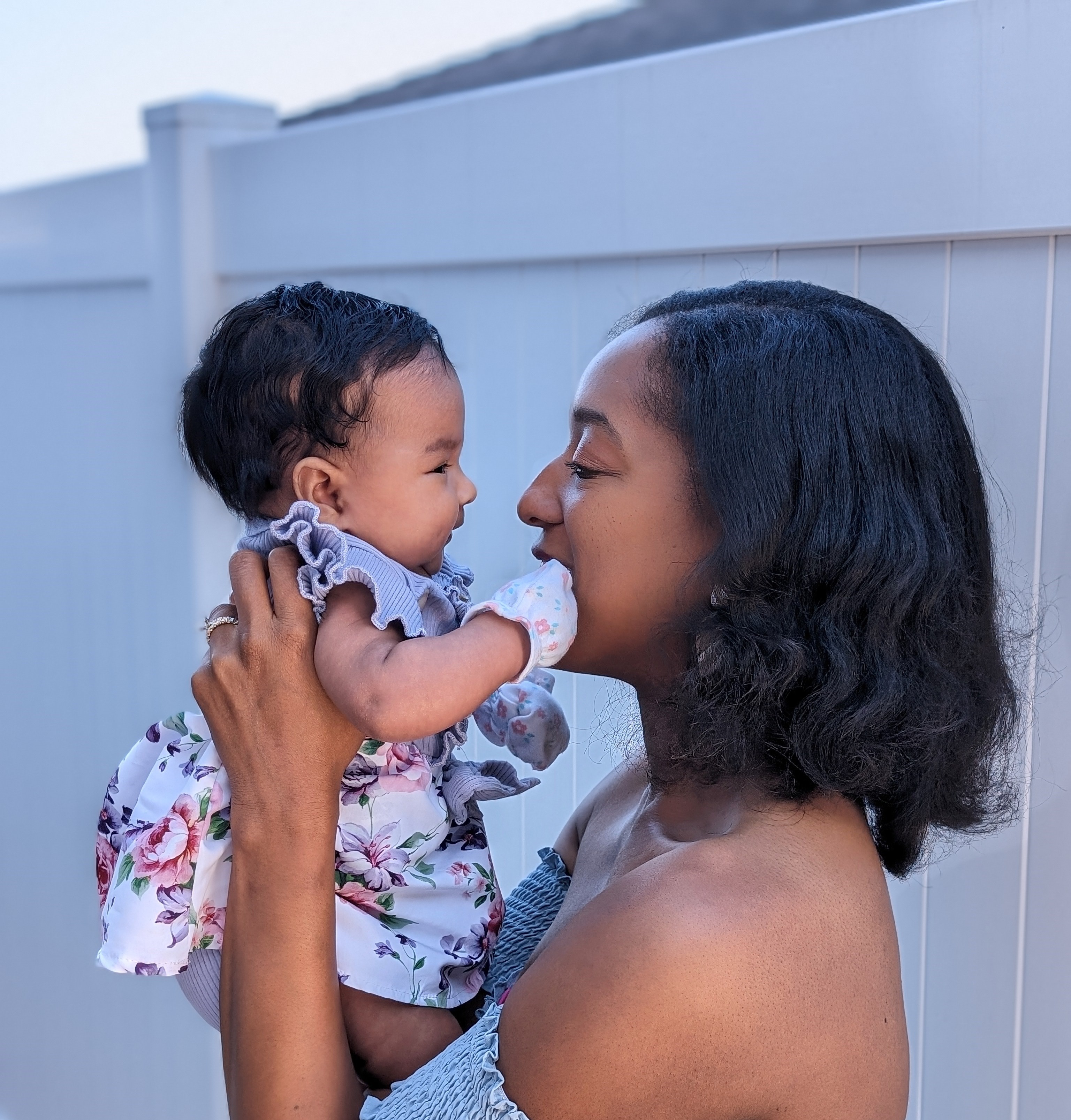
My daughter is five-months-old now. As I reflect on my pregnancy, labor and birth, I am glad I kept a journal. That same journal which aided me through pregnancy is now my source for documenting her milestones on her first year of life outside the womb. Life moves fast after having a baby. Babies grow and change rapidly during the first year. I am amazed at how much her little face has changed in these last few months. When I look at my daughter’s bright eyes and beautiful smile, I feel a sense of joy. She is worth every minute of my medicine-free birth.
 Curly Roots